
Dental implants in Barcelona
Dental implants, with no small print
What we do and how we do it
Replacing a missing tooth with one you bite on, brush and forget about. That is what a well-made implant is, and this page explains what it takes, how long it takes and what the price covers.
Quality dental implants
A solution to replace missing teeth, bite and smile like before.
Durability
Our promise is a long-lasting, natural, worry-free smile.
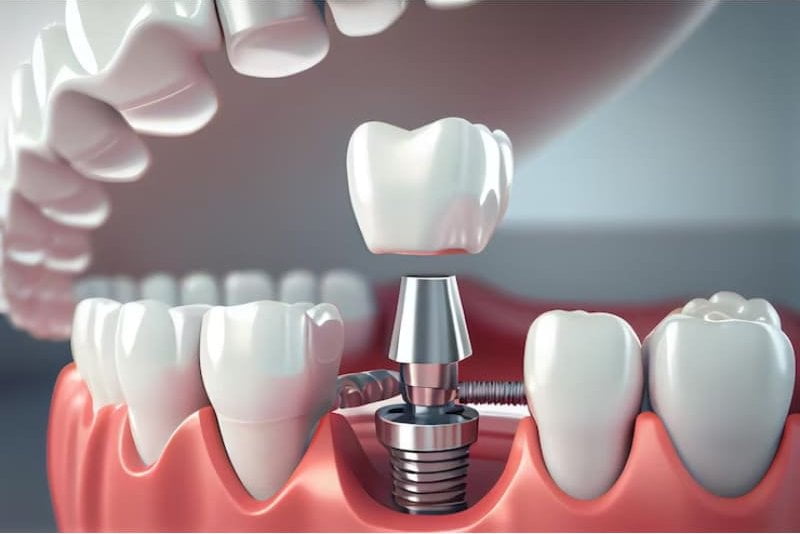
Our dental implants:
An implant is not a part you screw in and forget. It is an artificial titanium root that has to fuse with your bone, and whether that goes well decides whether the tooth lasts twenty years or works loose in two. Which is why the part that matters most happens before surgery: the assessment.
At the first appointment, which is free, we take an X-ray and a scan of your mouth to see how much bone there is, what quality it is, and where the nerve and the maxillary sinus run. That decides whether the implant can go straight in, whether bone has to be regenerated first, or whether your case calls for one of the techniques explained further down. And the quote comes out of that, fixed and in writing, before you commit to anything.
If you have been missing a tooth for a while, that appointment is worth it even if you have not decided to go ahead: the bone where the root used to be resorbs on its own, gradually, and the longer you wait the more likely you are to need a graft that today you might not.
What the 1,100 € implant includes
1,100 € per implant, fixed price. Fixed means that is what you pay for that tooth, with no extras appearing halfway through. It covers the four things needed to finish it:
- The titanium implant. The artificial root that integrates into the bone.
- The abutment. The connecting piece between implant and crown, and the one that takes the force of chewing.
- The custom crown. Made to the shape and colour of the teeth beside it, so it does not stand out.
- The visits. Both before surgery and during follow-up, until the tooth is finished.
What can fall outside it, and you are told in the quote rather than afterwards: bone regeneration or a sinus lift, if either is needed before the implant can go in. A case with several teeth is quoted as a whole, not by multiplying this figure.

- Increased initial stability: A stable implant after surgery minimizes the risk of micro-movements that prevent proper osseointegration.
- Less bone loss: This ensures the durability of the dental implant; over time, bone loss around implants can lead to complications.
- Reduced loosening: Having a hexagonal internal connection provides a tighter and more secure fit between the implant and the prosthetic component, helping to distribute chewing forces more evenly and reducing the risk of loosening over time.
- Efficient osseointegration: Having SLA surface means that implants can be placed crowns sooner, as they osseointegrate more efficiently.
REQUEST YOUR FREE ASSESSMENT APPOINTMENT
The first appointment is free and includes the assessment: X-ray, scan and a written plan with its price.
If you would rather ask before coming in, leave us your details and we will call you. It also works for a second opinion on a quote you already have from elsewhere, which is a more common request than you would think.
What are Dental Implants?
A dental implant is a titanium screw placed into the bone of the upper or lower jaw that does the job the root of the missing tooth used to do. The visible part is then mounted on top of it, and that can be a crown, a bridge or a full prosthesis.
There are three parts and it helps to tell them apart, because when something goes wrong it is usually one of them specifically. The implant sits inside the bone and is not visible; it is the part that has to integrate and the one that lasts decades. The abutment comes through the gum and connects the other two. The crown is the visible tooth, and it is the part most likely to need replacing over the years, much as a filling wears.
Advantages of dental implants
It behaves like a tooth. You bite with it, you brush it, and you never take it out. That is the big difference from a removable denture.
It leaves the neighbouring teeth alone. A conventional bridge means cutting down the two healthy teeth beside the gap. An implant stands on its own.
It slows bone loss. Bone that carries no load resorbs; the implant puts that load back and stops the process that eventually sinks the profile of the face.
It lasts, if looked after. With hygiene and check-ups, the titanium part can stay with you for the rest of your life.
It is cleaned like everything else. Brush, interdental brush and a water flosser. No tablets, no adhesives.
Book your appointment today:
FREE FIRST DENTAL VISIT
The first one in Barcelona Clinic is 100% free, complete dental study at no cost.
SMILE DESIGN
DSD technology that allows you to see the final result of your treatment before starting the treatment.
CONSCIOUS SEDATION
Conscious sedation program is designed to offer you a painless experience.
Types of dental implants
Single dental implant
One tooth is missing and the ones beside it are healthy. This is the most common case and the simplest: one implant in the gap and a crown on top.
The advantage over a bridge is that the neighbouring teeth are not cut down. The trade-off is time: a few weeks pass between placement and the final crown while the bone integrates the implant.


Complete dental prosthesis
For when no teeth are left in an arch, or the remaining ones cannot be saved. A full fixed prosthesis is mounted on a few implants; it stays in place and does not come out at night.
You do not need as many implants as teeth: four or six well distributed will support a whole arch.
Dental prosthesis with bridge
Two or more teeth in a row are missing. Implants go at each end of the gap and a bridge spans between them, so the teeth in the middle are supported without each one needing its own implant.
How many implants are needed depends on the length of the span and the quality of the bone, and it comes out of the assessment.
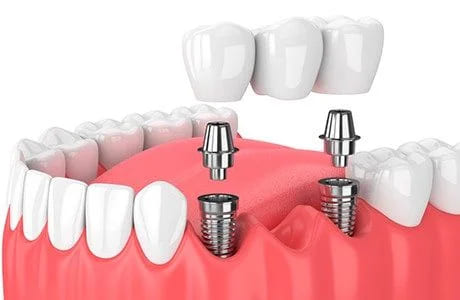
Complete process to place a dental implant
A placed implant is not a finished treatment: it is a tooth that needs checking, like any other. Check-ups are there to see how the gum around it is doing and to catch any inflammation early.
diagnosis
Personalized assessment and planning by a specialist using a 3D scanner .
guided surgery
Painless implant insertion with guided surgery, without cuts or sutures.
Healing
Healing and integration of the dental implant in the bone
(3 months).
Restoration
Placement of the restoration by intraoral CAD/CAM scanning.
If you clench your teeth at night, a night guard protects the implant crown, which does not warn you about excess force the way a natural tooth would.

Parts of a dental implant
Implant, abutment and crown. Each does a different job and each is replaced separately, which is the advantage of it being three parts rather than one.
- The crown: It is the visible part of the dental implant covering the abutment and simulating the tooth.
- The transepithelial abutment: it is the piece that adapts and couples the dental implant to the crown to support the prosthesis.
- The screw or dental implant: It is in charge of acting as a root, integrating itself into the bone in order to hold the structure.
How we plan an implant
An implant succeeds or fails on how it is planned, more than on how the surgery goes. This is how yours is prepared.
First the bone is measured: how much height and width there is, how dense it is, and where the structures that must be respected lie, above all the dental nerve in the lower jaw and the sinus above. That decides the length, the width and the angle of the implant, and whether bone has to be regenerated first.
Then the position is planned around the tooth that will go on top, not just around where the screw fits. An implant placed where there was bone but not where the tooth needs to be forces an awkward crown, which shows and which spreads the load badly.
And finally it is explained to you: how many sessions, how long between them, what you will be wearing in the meantime and what it costs. On one sheet, before starting.
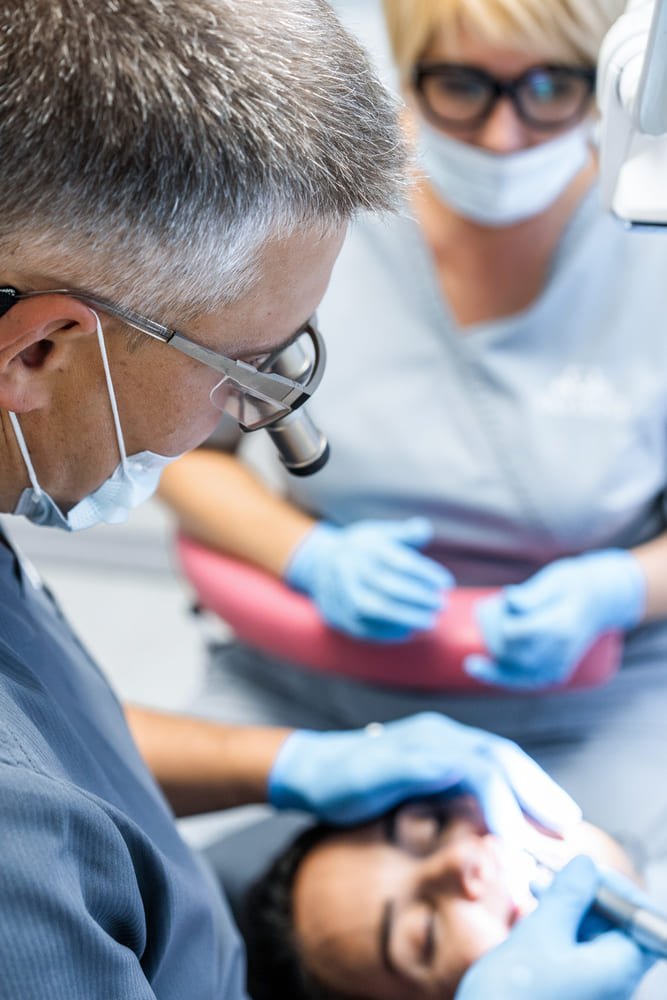
What guided surgery is
It means planning the implant on a computer, on the scan of your mouth, and making a guide, a kind of splint, that rests on your teeth and marks the exact point and angle for the implant to go in.
It does two things: it puts the implant where it was planned rather than where it happens to land, and it keeps well clear of the nerve and the sinus. With everything decided in advance the procedure is shorter, and in many cases it can be done without lifting the gum, which means less swelling afterwards.
What the intraoral scanner adds
An intraoral scanner is a camera about the size of an electric toothbrush that passes around the mouth and builds a three-dimensional model of your teeth in a few minutes.
It replaces the old tray full of paste, which is what makes many people gag, and it gives a truer copy: the implant is planned on that model and the crown is made from it. It is also stored, so how your mouth looked a year ago can be compared without taking impressions again.
What conscious sedation is
It is medication that lowers anxiety and leaves the patient relaxed and drowsy but awake, able to respond and follow instructions. It is not general anaesthesia: the area is still numbed locally, and the sedation works on the nerves rather than on the pain.
It is considered for people who find dental treatment hard to face, or for long procedures. A qualified professional prescribes and monitors it, and you have to come accompanied and not drive afterwards.
The real risk: peri-implantitis
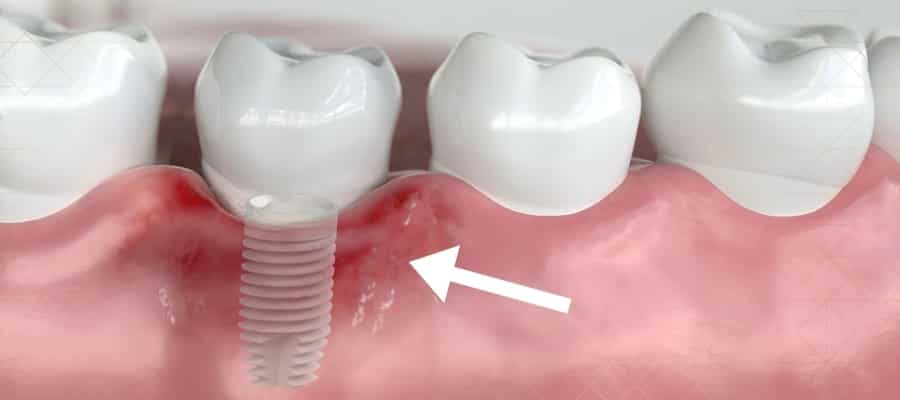
This is the complication that genuinely loses implants, and it is worth knowing about before having one. Peri-implantitis is an infection of the gum and bone around the implant: the inflammation eats away the bone holding it and, if it progresses, the implant works loose and falls out.
It starts without pain, and that is the problem. An implant has no nerve, so it does not warn you the way a tooth would. The signs come from the gum: it bleeds when you brush, it looks red or swollen around the implant, there is a bad smell, it recedes and the metal starts to show. By the time there is movement, a lot of options have already gone.
What raises the risk is known and can be worked on: smoking, which is the clearest factor; previous periodontitis that is poorly controlled, which is the same disease in your own teeth; uncontrolled diabetes; and hygiene that does not reach around the implant.
Which is why check-ups are not a commercial formality: caught early, peri-implantitis is stopped by cleaning and adjusting hygiene; caught late, it means removing the implant and regenerating bone before you can try again. If you smoke, saying so at the first appointment changes the plan rather than spoiling it.
Types of dental implants:
There is no standard implant. The material varies and the technique varies, and what decides which one is yours is the bone you have and the tooth being replaced.
Types of dental implants according to the material used
Two materials, and in practice one of them covers almost every case:
Titanium dental implants
This is what the vast majority of implants are made from, and it is because bone bonds to it: in the weeks after placement, bone grows tight against the titanium surface until the implant is anchored. That is called osseointegration and it is what holds the tooth up.
It takes the load of chewing for decades, it does not corrode and it is unaffected by hot or cold. It is metal-coloured, but it sits buried in bone and under the gum, so it does not show, unless the gum recedes over the years.
Zirconia Dental Implants
These are white ceramic instead of metal, and they are considered mainly in two situations: titanium allergy, which is uncommon but real, and very thin gum tissue that lets a little of the colour underneath show through, which is more noticeable on the front teeth.
In exchange they are less versatile: they come in fewer sizes and do not allow some solutions that titanium does. If your case is a candidate, you will be told at the assessment.
Types of dental implants depending on the technique used
And depending on how it is placed and when it is loaded, these are the options:
- Immediate load dental implants
Immediate-load implants let you leave with fixed temporary teeth within 48 to 72 hours of surgery, instead of waiting months with a gap or with something removable.
The temporary is not the final one: it is a lighter piece meant to let you carry on normally while the bone integrates the implant. After two or three months it is replaced by the definitive tooth. Not every case allows it, because the implant has to be firm from day one, and that is down to the bone.
- Dental implants with guided surgery
In guided implantology the implant is planned on a computer and placed through a custom-made guide that marks the exact point and angle.
You gain precision and safety, because the path is decided with the nerve and the sinus in view, and in many cases it allows surgery without opening the gum, with less swelling afterwards.
- Dental implants using the all on four and all on 6 technique
The all-on-four and all-on-six technique restores a whole arch on just four or six implants, placed where the best bone is and some of them deliberately angled to make use of it.
It is the usual route for someone who has lost all their teeth, and its advantage is that it often avoids a bone graft and allows you to leave the same day with a fixed temporary prosthesis.
- Bone-free dental implants
Missing bone is the most common reason an implant gets ruled out, and in most cases it no longer has to be. These are the ways round it when the bone will not do:
Zygomatic dental implants
Zygomatic implants anchor into the cheekbone rather than the upper jaw, because it is much denser bone and hardly ever resorbs. They are used when there is nothing left to hold on to in the upper arch.
They avoid grafting and cut the timeline considerably, but they are major surgery: they demand millimetre planning and a team with specific experience in the technique.
Dental micro-implants
Micro-implants are narrower than conventional ones. They fit where the bone is thin and will not take a standard implant, which is common when a tooth has been missing for years.
They carry less load than a full-size implant, so they are used in particular places and for particular solutions, not as a general substitute.
Maxillary sinus lift
In the upper arch, above the back teeth, sits the maxillary sinus. When the bone separating them has worn down to almost nothing, the sinus membrane is carefully lifted and the space is filled with material that the body itself turns into bone.
That bone needs a few months to mature before the implant goes in, except in cases where both can be done in the same procedure. It is what turns a “there is no bone” case into a treatable one.
Frequently Asked Questions
Is the dental implant procedure painful?
You feel no pain during surgery: the area is numbed, just as it would be for a filling. What you notice is pressure and the noise, nothing more.
Afterwards, once the anaesthetic wears off, there is soreness and swelling, more on the second day than the first, controlled with the painkiller you are prescribed. It is usually a good deal less than people expect: most are surprised to have gone to work the next day. If you are afraid of the dentist, say so at the first appointment, because there are ways of approaching it that make it far easier.
How long does the dental implant process take?
Two to three months pass between surgery and the final tooth, which is how long the bone takes to integrate the implant. That is not time in the chair: it is short visits and waiting.
The timeline stretches if bone has to be regenerated or the sinus lifted beforehand, because those need months of their own. And it shortens in cases that allow immediate loading, where you leave with temporary teeth in two or three days. Which one is yours comes out of the assessment, and you get it with dates.
Can I smoke with dental implants in place?
You can, but it is the factor that loses the most implants, so the honest answer is not a plain yes. Tobacco reduces blood supply to the gum, slows healing and multiplies the risk of peri-implantitis, the infection that works an implant loose.
The minimum we ask is that you stop for the weeks around surgery, which is when integration is decided. And if this is the moment to stop altogether, the treatment is a good excuse. Smoking does not rule you out and will not earn you a lecture: it changes the follow-up, which becomes more frequent.
How should I care for my dental implants after the procedure?
Like a tooth, with one difference: around an implant you have to reach better. Brushing twice a day, an interdental brush in the gaps, and floss or a water flosser where the gap is tight. That area is exactly where peri-implantitis starts.
And check-ups. At least once a year, with a professional clean, because an implant does not hurt when it starts going wrong and is only found by looking.
Are the results of dental implants permanent?
The titanium part, the one in the bone, can last a lifetime, and in many patients it does. What is not forever is the crown: it is the part that works and wears, and over the years it may need replacing, much like a filling.
What decides how long it lasts is not the brand of implant but two things: hygiene around it and no uncontrolled gum infection. And if you clench your teeth, a night guard is part of the equation.
How much does a dental implant in Barcelona cost?
At our Barcelona clinic, 1,100 € per implant, fixed price, covering the titanium implant, the abutment, the custom crown and the follow-up visits. That is what you pay to have that tooth finished.
What makes a whole case vary is not the price of the part but how many are needed and whether the bone has to be prepared first with regeneration or a sinus lift. That is why the quote is given in full and in writing after the assessment, which is free, rather than over the phone.
What type of material is used for dental implants?
Titanium in practically every case: bone bonds to it and it withstands decades of chewing. The alternative is zirconia, a white ceramic, kept for titanium allergy or very thin gum tissue on the front teeth.