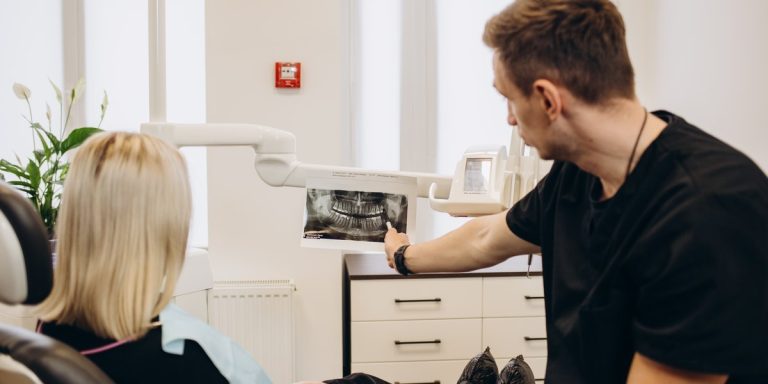
Dentist vs dental clinic: a dentist is a person and a clinic is a place, the licensed healthcare center where dentists see patients. Between a dentist and an odontologist there’s no practical difference: odontologist is one of the two qualifications that allow someone to practice as a dentist in Spain; the other is medical stomatologist. Orthodontists, endodontists and periodontists are dentists who focus mainly on one part of the work.
When you look for an appointment, you come across names that are used as if they meant the same thing, and they don’t always. Sorting them out helps with something very concrete: knowing who’s going to treat you, what each person you see at the practice can do, and which questions make sense to ask before you accept a quote.
Contents
- Dentist or odontologist: what’s the difference?
- What a general dentist is and what they handle
- Dentist vs orthodontist: how are they different?
- What a dental clinic is
- Who’s who at the practice: hygienist, dental technician and assistant
- A solo dentist or a clinic with several: what changes for you
- Five questions to ask the center you choose
- How our clinic is organized
- Frequently asked questions
Dentist or odontologist: what’s the difference?
At the practice, none. The word “dentist” doesn’t correspond to any degree: it’s the everyday way of naming whoever looks after your teeth and mouth. In Spain, two professionals can practice as dentists:
- The odontologist. Holds the university degree in Dentistry, called Odontology in Spain.
- The stomatologist. A doctor specialized in Stomatology: they studied Medicine and then specialized in the mouth. Royal Decree 183/2008 declared this specialty one to be phased out, without stomatologists losing their right to practice.
For practical purposes, both do the same work. Law 44/2003 on the organization of the healthcare professions, in article 6.2.c, gives them the same functions as dentists: preventing, diagnosing and treating diseases and anomalies of the teeth, mouth, jaws and surrounding tissues. Both can also prescribe the medicines, prostheses and medical devices in their field.
What a general dentist is and what they handle
They’re your mouth’s first point of contact, the one who does your checkup. They look at your teeth and gums, decide which tests are needed, read the X-rays and treat what comes up often over a lifetime: cavities, fillings, uncomplicated extractions, cleanings or crowns.
When a case calls for more hours of focus on one area, they bring in the colleague who works in that area or refer you to them.
Dentist vs orthodontist: how are they different?
An orthodontist is a dentist who focuses on orthodontics: moving teeth and correcting how the two arches fit together when you close your mouth, with braces or clear aligners.
Today, in October 2026, there’s no official orthodontics specialty in Spain: on July 9, 2026, the Ministry of Health turned down the creation of six specialties for dentists (orthodontics, endodontics, periodontics, oral surgery, pediatric dentistry and prosthodontics), and the decision has been appealed.
So when a dentist presents themselves as a specialist in orthodontics, they’re referring to the training they’ve done after their degree and to the fact that they devote their work to it, not to an official specialty title.
The split is similar for the rest of the work in the mouth:
- Endodontics: treating the nerve of the tooth, what everyone calls killing the nerve. We cover it in endodontics in Barcelona.
- Periodontics: the gums and the bone that holds each tooth. More in gum treatment.
- Implantology: replacing missing teeth with dental implants.
- Pediatric dentistry: children’s mouths, from the first baby teeth to adolescence. It’s in pediatric dentistry.
- Oral surgery: difficult extractions, such as wisdom teeth that haven’t come in, cysts and other procedures, which at our clinic are handled by the maxillofacial surgery team.
If what you want is to straighten your teeth, the options are explained in orthodontics in Barcelona.
What a dental clinic is
It’s a healthcare center. Every dental clinic, and also the practice of a dentist who works alone, needs a health authorization before it starts seeing patients. In Catalonia it’s granted by the Department of Health (Departament de Salut), under Decree 151/2017. On that point there’s no difference between a solo practice and a large clinic: both are healthcare centers and both need that authorization.
Where you do notice it is in size and in how the work is divided. A small practice is organized around one person. A clinic brings together several dentists with different focuses, hygienists and support staff, and usually works with a lab every day.
Who’s who at the practice: hygienist, dental technician and assistant
More people than dentists work at a clinic, and each one has a role:
-
Dental hygienist. Holds the higher technical qualification in Oral Hygiene. They work on prevention and on teaching you to look after your mouth, and as the dentist’s assistant and collaborator they apply fluoride, place fissure sealants, remove tartar and stains, and polish the teeth.
They don’t prescribe treatments or prostheses, write prescriptions, give anesthesia or do fillings or other procedures: diagnosis and treatment are decided by the dentist. They’re usually the one who does your dental cleaning.
- Dental technician. Holds the higher technical qualification in Dental Prosthetics. In their lab they design, make and repair the prostheses, orthodontic appliances and splints the dentist orders, following the dentist’s prescription. Their place is the lab: the impressions of your mouth and the fitting of the prosthesis are done by the dentist. We explain the types in dental prostheses.
- Assistant. Works alongside the dentist at the chair, hands over the materials needed at each step, and cleans and sterilizes everything that’s been used before the next patient comes in.
A solo dentist or a clinic with several: what changes for you
You can get it right with either. These are the differences you’ll notice as a patient:
- Each treatment in the hands of someone who focuses on it. With a single dentist, the same person does everything. With several, implants are placed by the one who does implants and orthodontics is handled by the one who does orthodontics, and difficult cases are discussed as a team.
- Fewer trips back and forth. When a treatment needs two or three professionals and they aren’t in the same place, you have to go somewhere else, repeat the first visit and wait for another quote.
- Tests in the same place. X-ray, intraoral scan or dental CT scan: if the center doesn’t have them, they’re done elsewhere and the diagnosis is delayed.
- Treatments that last months. In orthodontics or a full-mouth treatment with implants, with several professionals your appointments don’t depend on one person’s vacation or schedule.
- Personal attention. It isn’t tied to the size of the center. A dentist who works alone or a large team can both treat you with a personal touch, and it’s something you find out at the first appointment, not before.
Five questions to ask the center you choose
- Where is its health authorization? Authorized clinics have to display the badge that proves it in a visible place, and their advertising must include the health registration number.
- Who will treat me, and what’s their registration number? To practice, a dentist has to be registered with the professional college. In Catalonia that’s the COEC (Col·legi Oficial d’Odontòlegs i Estomatòlegs de Catalunya), whose website has a public search tool where you can check by first name, surname or registration number.
- Will I be examined before I’m given a price? A reliable quote comes from an examination and, when the case calls for it, X-rays.
- Can I take the plan with me in writing? If it details what’s done on each tooth, with what material and which checkups are included, you can read it calmly outside the practice and put it next to other proposals.
- Who will do each stage, and which checkups are included in the price? That way there are no surprises halfway through treatment.
How our clinic is organized
We’ve brought together in one center the treatments that are often combined: implants, orthodontics, gums, endodontics, pediatric dentistry and surgery. For people who are afraid of the dentist’s chair, we also offer conscious sedation. The first visit and the quote are free: you leave with a written plan and a fixed price. You can see what each treatment costs on our dentist price list in Barcelona.
Book an appointment
Choose the day and time that suit you for your free initial assessment, or call us.
Book onlineFrequently asked questions
Can an odontologist prescribe medication?
Yes. They can prescribe the medicines, prostheses and medical devices in their field, which covers the teeth, mouth, jaws and surrounding tissues. A stomatologist has those same functions as a dentist.
Does the owner have to be a dentist?
A clinic can belong to a dentist or a company, but dentists organize and provide the care: Royal Decree 1594/1994 requires dental practices to be run and staffed personally by an odontologist or stomatologist. In Catalonia, each clinic also has a clinical lead with a healthcare qualification responsible for the quality and safety of care. For you, what matters is which dentist treats you and whether they’re registered.
Can the hygienist do a filling or pull a tooth?
No. Fillings and other procedures are outside what they can do, as are giving anesthesia and writing prescriptions. Their field is prevention: cleaning, fluoride and sealants. Pulling a tooth, doing a root canal or deciding what treatment you need is up to the dentist.
A solo practice or a team of several dentists: which suits me?
For checkups, cleanings or a cavity, either works if you trust the person treating you. If your case combines several things, such as gums, implants and orthodontics, having them in the same center saves you referrals and repeat quotes. Either way, the price should come from a diagnosis with tests and be given to you in writing.