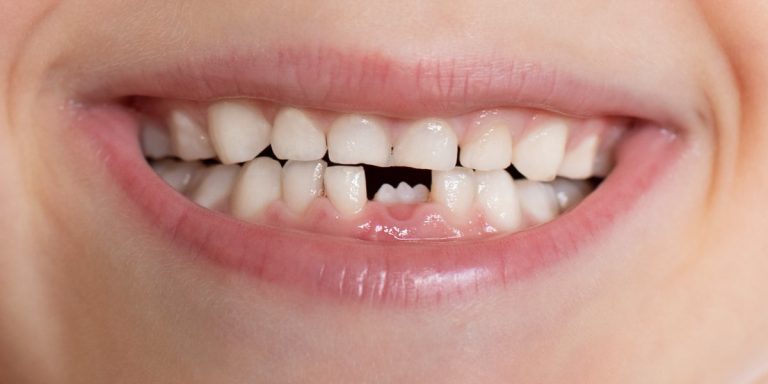
Baby teeth start coming in at around 6 months, the bottom front teeth first, and by age 2 or 3 a child has all 20. They start falling out at around age 6, and the last ones go between ages 10 and 12. Normally they fall out on their own: your child can wiggle them gently, but you shouldn’t pull one that’s still firm.
A baby’s first teeth and the first tooth that falls out are two moments families remember. Here’s when baby teeth come in and in what order, what teething symptoms to expect, when they fall out, how to pull a baby tooth that’s already loose, why they matter even though they’ll fall out, and when to see a dentist.
Contents
When baby teeth come in
According to the American Dental Association (ADA), all 20 baby teeth are already formed at birth, and they start to break through at around 6 months. The NHS, the UK’s public health service, explains that the majority of babies start at around that age, although some start before 4 months, others after 12 months, and some babies are even born with a tooth.
This is the approximate order the NHS gives:
- Central incisors, the front teeth: at around 6 months.
- Lateral incisors, on either side: at around 8 months.
- First molars: at around 12 months.
- Canines: at around 18 months.
- Second molars: at around 24 months.
The bottom teeth usually come in before their partners in the upper jaw. The majority of children have all their baby teeth between ages 2 and 3.
Teething symptoms
Sometimes teeth come in without any discomfort, or with mild symptoms that last a few days. Other times, according to the NHS, you may notice that your baby:
- has red, swollen gums where the tooth is coming through;
- has a slightly raised temperature, but below 38°C (100.4°F);
- gets a rash on their face;
- drools more than usual and chews on everything;
- is fussier and sleeps worse.
The NHS makes clear that there’s no evidence teething causes diarrhea. If your baby has a temperature of 38°C (100.4°F) or higher, diarrhea or any symptom that worries you, see your pediatrician: don’t just put it down to teething.
When baby teeth fall out
As permanent teeth come in, they gradually dissolve the root of the baby tooth, and by the time it’s loose, little more than a bit of gum is holding it in place. That’s how the American Academy of Pediatrics explains it. This is the timeline Cleveland Clinic gives:
- Ages 6 to 7: central incisors, usually the two lower ones first and then the upper ones.
- Ages 7 to 8: lateral incisors.
- Ages 9 to 10: lower canines.
- Ages 10 to 11: first baby molars.
- Ages 11 to 12: upper canines and second baby molars.
There’s some leeway: according to the same source, it usually follows when the teeth came in, so children who got their teeth early tend to lose them sooner. At around age 6, the first permanent molar also comes in, behind the baby teeth and without any of them falling out. That molar is permanent: nothing replaces it.
How to pull a baby tooth at home without pain
Usually, there’s no need to pull it. Cleveland Clinic explains that the majority of loose teeth fall out painlessly while the child is eating or playing, and that it’s fine for them to wiggle it gently with their tongue or a finger, with clean hands. If the tooth stays in too long, the gum can close around it and the permanent tooth has a harder time coming in.
If the tooth is already very loose and your child asks for help, the American Academy of Pediatrics advises holding it firmly with a tissue or a piece of gauze and pulling it out with a quick twist. What you shouldn’t do is pull on a tooth that’s still firm. If a tooth just won’t come loose, the dentist can assess whether to remove it.
If it hurts afterward or the gum swells, Cleveland Clinic says a dose of acetaminophen (paracetamol) or ibuprofen suited to your child’s age can help.
Why baby teeth matter even though they fall out
The ADA points out that children use them to chew and to speak clearly, and that they also hold the space for the permanent teeth. If one is lost too early because of a cavity or an injury, the neighboring teeth can drift into the gap and the permanent tooth can come in crooked for lack of space, as Cleveland Clinic and the American Academy of Pediatrics explain.
To prevent this, the ADA explains that the dentist may recommend a space maintainer, a small appliance that holds the gap open until the permanent tooth comes in.
If the teeth have already come in crowded, our article on crooked teeth covers the causes and solutions, and our orthodontics page covers the treatments for children and adults.
How to care for baby teeth
- From the first tooth: the NHS recommends brushing twice a day, including once before bed, with a thin smear of toothpaste containing a minimum of 1,000 ppm fluoride. Until age 3, parents do the brushing.
- Ages 3 to 6: a pea-sized amount of toothpaste with 1,000 to 1,500 ppm; spit it out and don’t rinse.
- First dental visit: the NHS advises going when the first teeth come in or before 12 months, so your child gets used to it and the dentist can catch any problem early.
- Sealants: when the permanent molars start coming in, at around age 6 or 7, their grooves can be sealed to protect them from cavities, according to the NHS.
At our clinic, the first pediatric dentistry visit is free.
When to see a dentist
Cleveland Clinic advises getting checked if:
- your child loses a tooth, even a baby tooth, from a blow or a fall;
- the permanent teeth aren’t coming in;
- your child is in a lot of pain;
- baby teeth fall out before age 4, or none has fallen out by age 8 or 9.
If a baby tooth is knocked out whole, don’t put it back in place: the NHS warns that this can damage the permanent tooth forming underneath. Bring your child to the clinic as soon as possible.
Pediatric dentistry
Check-ups, cavity treatment and children's orthodontics, with care adapted to each age. Free first visit.
See the treatmentFrequently asked questions
Why are my baby’s gums swollen?
The usual reason is that a tooth is coming in: the NHS lists red, swollen gums in that area among the symptoms of teething. If there’s a temperature of 38°C (100.4°F) or higher, or any other symptom that worries you, see your pediatrician.
Why are babies born without teeth?
They’re born with all 20 baby teeth already formed inside the gums, according to the ADA, and the teeth start to break through at around 6 months. A small number of babies are born with a tooth already showing.
Do baby molars fall out and grow back?
Baby molars fall out between ages 10 and 12, and according to the American Academy of Pediatrics, permanent teeth replace them at around 13. The first permanent molar, on the other hand, comes in at around age 6 behind the baby teeth, without replacing any of them, and doesn’t fall out.
What if my baby’s teeth come in crooked?
Mention it at the first visit, which the NHS recommends when the first teeth come in or before 12 months. The dentist checks how they’re coming in and whether there’s room for the permanent teeth.
How many baby teeth are there?
Twenty: ten upper and ten lower. On each side of each jaw there are two incisors, one canine and two molars.