A broken tooth has four possible repairs: a filling, a rebuild, a root canal with a crown, or an extraction. Which one you need isn’t decided by the pain, but by how much healthy tooth is left and whether the break has reached the nerve. That’s why “I’ve broken a tooth” can end in a €40 filling or in a root canal from €175 plus a €270 crown.
With a broken tooth it’s easy to let the days go by, especially if it doesn’t hurt. Here are the four repairs in order of how much work they involve, with what each one costs at the clinic, what moves you from one to the next, when you can eat normally again if the tooth has to come out, and what to do on the day it breaks.
Contents
What decides how a broken tooth is repaired
Two facts, and you can’t see either of them from the outside:
- How much healthy tooth is left. A molar works like a piece with walls. If it still has nearly all of them, the repair is simple and holds up. If it has lost several, it has to be reinforced or, if too much is gone, there’s nothing left to hold anything in place.
- Whether the break has reached the nerve. As long as it stays in the hard part, the repair is on the surface. If it reaches the pulp, which is where the nerve is, the inside has to be treated first.
Both are found out with an examination and an X-ray. That’s why a reliable quote for a broken tooth is given with the tooth in front of the dentist, not over the phone.
The four repairs, in order
Filling a broken tooth, €40
It works when only a little is missing: a small cavity or a corner that has chipped off without reaching the nerve. The area is cleaned and filled with tooth-colored composite, in one visit and with local anesthesia.
It costs less than the other three, and it’s also the one you can lose by waiting, because a cavity or a crack that a filling can seal today keeps growing. What a filling involves and what each type costs is explained in fillings and cavities in Barcelona.
Rebuilding a broken tooth, €50
Yes, a broken tooth can be rebuilt as long as the nerve is healthy and there’s enough structure left to build on. This is no longer about filling a hole: the part of the tooth that broke off is remade, for example a cusp that cracks when you bite something hard. More detail in dental reconstruction in Barcelona.
Root canal from €175 and a €270 crown
When the break or the decay reaches the nerve, sealing it over isn’t enough. The canals inside the root have to be emptied, cleaned and sealed: that’s a root canal, what many people call “killing the nerve.”
It’s done under local anesthesia, so it shouldn’t hurt during treatment, and according to the NHS it usually takes two or more appointments. The price starts at €175 because a tooth with one canal isn’t the same job as a molar with three or four. The whole process is explained in root canal treatment in Barcelona.
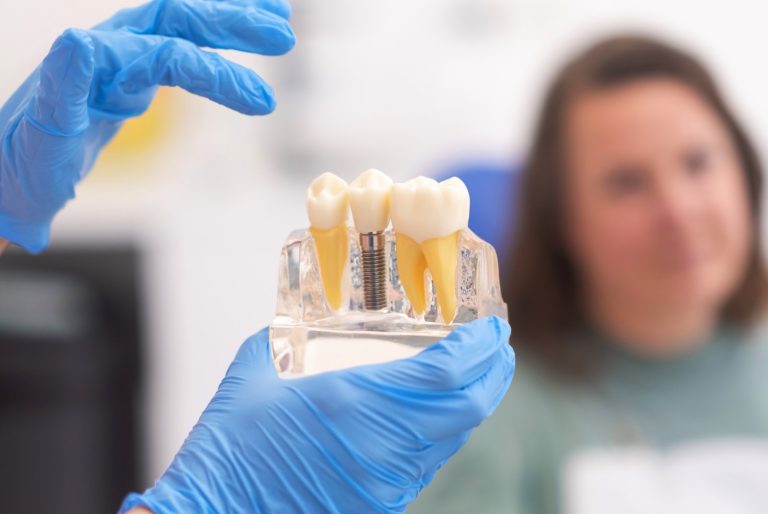
After a root canal, a molar usually needs a crown, a cap that covers it completely and spreads the force when you chew. The reason is mechanical: between the break, the decay and the opening made to reach the canals, the tooth has lost a lot of its structure.
It isn’t, as is often said, that the tooth “dries out” when the nerve is removed: a 1994 study that compared, in pairs, root-canal-treated teeth and healthy teeth from the same person found no difference in moisture (12.35% in the healthy teeth versus 12.10%).
What has been measured is what happens without a crown: in a University of Iowa study that followed 203 root-canal-treated teeth for about ten years, the teeth without a crown were lost at a rate 6 times higher than the ones with a crown.
Extracting the tooth, €40, and how to replace it
When the tooth is broken off at the gumline or below it, or so little is left that there’s nothing to hold a crown, it can’t be saved and has to come out. The extraction costs the same €40 as a filling, but it leaves a gap that’s worth dealing with.
The fixed options are an implant, which costs €1,100 with its crown at our clinic (dental implants in Barcelona), or a bridge supported by the teeth on either side; we compare both in dental implant vs bridge. If several teeth are missing, there’s also a dental prosthesis.
When can I eat normally after a tooth extraction?
If the tooth does have to come out, the NHS advice for after a wisdom tooth removal works as a guide:
- If it bleeds, press a clean gauze pad on the gap for ten minutes or longer.
- Eat soft or liquid food until you can chew comfortably, and leave hard food for later.
- No very hot drinks for the first few days: coffee is better lukewarm. No alcohol or smoking either.
- Rinse gently with mouthwash or warm salt water, and brush the rest of your mouth carefully.
You can eat normally once chewing no longer bothers you, and for the majority of people that takes a few days: pain and swelling should start to improve after a day or two. As for rest, nearly everyone is back to normal life the next day, and the more complicated extractions can need one to three days off work.
Why the same repair costs different amounts at each clinic
When you compare quotes, look at three things, because they explain nearly all the differences:
- The surfaces of the filling. A cavity on one side of the tooth isn’t the same as one on three sides, and some clinics charge per surface.
- The canals in the root canal. A tooth with one canal and a tooth with four are different jobs, and they’re priced differently.
- Whether the crown is included. This is the one that catches many people out, because the crown can cost more than the root canal itself. Always ask whether it’s included.
Signs you shouldn’t wait
- It hurts when you chew, on and off, or you get a sharp twinge with cold or heat. That’s how the American Association of Endodontists describes a cracked tooth. A crack that isn’t treated gets worse and can end up costing you the tooth, so it’s worth having it seen soon.
- It hurts on its own, without biting anything. According to the same association, spontaneous pain comes when the pulp is already damaged, and in a cracked tooth with an affected pulp what it points to is a root canal and a crown.
- There’s swelling, pus or a lump on the gum. It may be an abscess, and according to the NHS an abscess needs treatment and doesn’t heal on its own.
- You find it hard to breathe, swallow or open your mouth, or the area around your eye swells. That’s a matter for the emergency room, without waiting for an appointment.
What to do if you’ve broken a tooth today
Until you get to the clinic, bite gently on a clean, damp piece of gauze over the area, as the American Association of Endodontists recommends, and chew on the other side. Don’t put an aspirin or any other painkiller on the gum: painkillers are taken by mouth, never placed on the tooth. If your face is swelling, that comes before everything else.
The first visit and the quote are free. Knowing which of the four repairs you’re facing costs nothing, and it’s the information you need to decide.
Dental reconstruction
When a broken or worn tooth can be saved and which technique suits each case. Free assessment.
See the treatmentFrequently asked questions
I have a broken tooth and it doesn’t hurt. Can I wait?
It isn’t an emergency for this afternoon, but it won’t get better on its own either. No pain only means the nerve isn’t irritated yet; the broken area is still exposed, and an untreated crack gets worse. What today is a €50 rebuild can end up as a root canal with a crown.
Can an infected tooth be pulled?
Yes. According to the NHS, a dental abscess is treated by draining the pus and then doing a root canal or taking the tooth out, under local anesthesia. Antibiotics are sometimes prescribed as well. What an abscess won’t do is heal on its own.
Can a broken tooth that already had a root canal be fixed?
It depends on how much structure is left. If there’s enough, it’s rebuilt and protected with a crown. If the crack splits the root vertically, the American Association of Endodontists considers extraction or surgery on the root.
Does it hurt after a root canal?
Not during treatment, thanks to the anesthesia. Afterward, the area may feel swollen and tender, and according to the NHS it should improve within a couple of weeks; in the meantime, take paracetamol (acetaminophen) or ibuprofen if it hurts.
How long does it take to pull a tooth?
A simple extraction is usually a matter of minutes. What makes the appointment longer is a tooth broken below the gum, with curved roots or fused to the bone, which has to be taken out in pieces.