Mouthwash doesn’t replace your toothbrush or floss: it’s an extra. Chlorhexidine mouthwash is an antiseptic that greatly reduces plaque, but it stains teeth and changes your sense of taste, so it’s used for limited periods and when your dentist recommends it. Fluoride mouthwash helps prevent cavities and is used at a different time from brushing, not right after.
The pharmacy shelf has dozens of mouthwashes: with chlorhexidine, with fluoride, alcohol-free, antibacterial, for gums, for breath. Here’s what each type is for according to the studies, what side effects chlorhexidine has, how to use a mouthwash without canceling out the fluoride in your toothpaste, and which one makes sense for what’s going on in your mouth.
Contents
What mouthwash is for
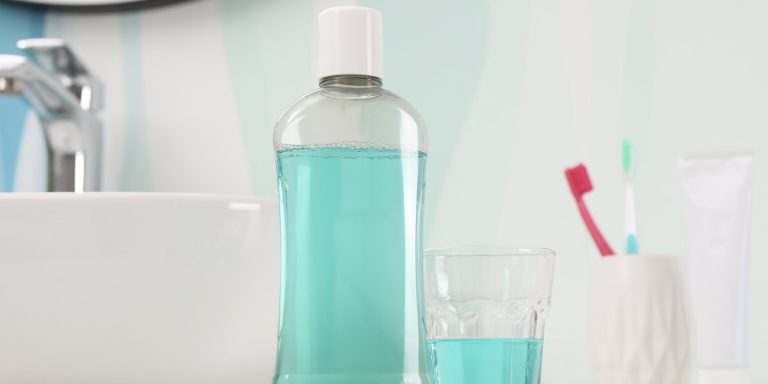
Mouthwash and mouth rinse are the same thing: a liquid you swish around your mouth and spit out. What it does depends on what’s in it:
- With chlorhexidine. It’s an antiseptic. It reduces bacterial plaque and, to a lesser extent, gum inflammation.
- With fluoride. The NHS, the UK’s public health service, explains that a fluoride mouthwash can help prevent tooth decay.
- For breath. These are the ones you’ll see on almost every shelf. If your problem is bad breath, the article on solutions for bad breath explains what a mouthwash can and can’t do.
None of them removes tartar: according to the ADA, plaque that isn’t removed hardens into tartar, and only a cleaning at the dental office can remove it. The reviews we cite below always tested mouthwash in addition to brushing, never instead of it.
What chlorhexidine mouthwash is for
The 2017 Cochrane review on chlorhexidine mouthwash pooled 51 studies with 5,345 people. Its conclusions, for people who use it in addition to brushing:
- Plaque. High-quality evidence of a large reduction in plaque at 4 to 6 weeks and at 6 months.
- Gingivitis. High-quality evidence of a reduction in gum inflammation in people with mild inflammation, but so small that the authors don’t consider it relevant in practice. For moderate or severe inflammation, there wasn’t enough data.
- Tartar. Inconclusive results.
- Concentration. There’s no evidence that one concentration of chlorhexidine works better than another.
That’s why dentists recommend it at specific times and for a limited period, rather than as an everyday mouthwash. Use it for as long as you’ve been told to.
Which mouthwashes contain chlorhexidine?
The ones that do say so on the label, along with the concentration, and they’re usually sold as gum care or antiseptic mouthwashes. If the label doesn’t say so, it doesn’t contain it. Before you buy one on your own for a gum problem, it’s a good idea to get a checkup: mouthwash doesn’t treat what’s causing the bleeding.
Chlorhexidine side effects
The same Cochrane review reports these effects:
- Tooth stains. A large increase in surface stains as early as 4 to 6 weeks, and also at 3 and 6 months. They’re surface stains; the article on tooth stains explains how they’re removed.
- Changes in taste, reported in 11 studies.
- Irritation of the lining of the mouth: stinging, mild peeling and small sores, reported in 13 studies.
- A burning sensation in the mouth, reported in 9 studies.
MedlinePlus, the drug information website of the U.S. National Library of Medicine, adds that chlorhexidine can increase tartar and leave permanent stains on fillings in the front teeth.
If you notice any of these effects, talk to your dentist before you continue. And if you get a rash, your mouth or throat swells, or you find it hard to breathe, get urgent medical care: it could be an allergic reaction.
Fluoride mouthwash
Fluoride mouthwash has a different goal: protecting the enamel against decay. A 2016 Cochrane review of 37 trials with 15,813 children and teenagers found that using it regularly under supervision, almost always at school, is linked to 27% fewer decayed tooth surfaces in permanent teeth, with moderate certainty.
How to use mouthwash
For everyday mouthwashes, fluoride ones included, the NHS gives three rules:
- Don’t use it right after brushing. It washes away the concentrated fluoride that toothpaste leaves on your teeth.
- Choose another time of day, for example after lunch.
- Don’t eat or drink for 30 minutes after using a fluoride mouthwash.
Measure out the amount shown on the bottle, swish it around your mouth and between your teeth for the time it says, spit it out and don’t swallow it. If the alcohol stings, there are alcohol-free versions of almost every type.
Chlorhexidine is used as your dentist directs. As a reference, MedlinePlus describes 15 milliliters (about one tablespoon) for 30 seconds, twice a day, spitting it out without swallowing, and not rinsing with water, brushing or eating right afterward.
Which mouthwash to choose for what you need
Mouthwash for gingivitis
If your gums bleed, mouthwash isn’t the treatment. According to the NHS, gum disease comes from plaque building up on your teeth, and in its early stages it’s treated by removing that plaque: brushing, cleaning between your teeth and a cleaning at the dental office.
Chlorhexidine can help for a while but, as we’ve seen, its effect on mild inflammation is small. If there are pockets under the gum, the treatment is periodontics.
Antibacterial mouthwash for everyday use
If you brush well and clean between your teeth, you don’t need one. If you want to use one every day, fluoride mouthwash is the type with evidence for preventing cavities; chlorhexidine isn’t recommended as a habit without a dentist’s advice, because of the stains and the changes in taste.
If you’re not sure which one suits you, we’ll tell you at your checkup. The first visit and the quote are free.
Periodontics
Signs of gum disease and treatment by stage, from cleaning and scaling to periodontal surgery. Free assessment.
See the treatmentFrequently asked questions
What is mouthwash?
A liquid for rinsing your mouth after brushing and flossing, also called mouth rinse. Depending on what’s in it, it reduces plaque, like chlorhexidine, helps prevent cavities, like fluoride, or freshens your breath. It’s always used in addition to your toothbrush, not instead of it.
How long can you use chlorhexidine mouthwash?
For as long as your dentist tells you. The studies in the Cochrane review tested it for between 4 weeks and 6 months, and tooth stains appeared at every one of those time points. That’s why it’s used for limited periods.
Do chlorhexidine stains come off?
On teeth they’re surface stains, and MedlinePlus advises seeing your dentist to have them removed with a cleaning; at the clinic, an oral cleaning costs €30. On fillings in the front teeth, however, they can be permanent.
What’s the point of mouthwash if I already brush?
If you brush well twice a day with fluoride toothpaste and clean between your teeth, mouthwash adds little. A fluoride one makes sense if you get a lot of cavities, and chlorhexidine for a while if your dentist recommends it.
Can I rinse after brushing?
It’s better not to, either with water or with an everyday mouthwash, unless your dentist has told you otherwise. The NHS recommends spitting out the toothpaste without rinsing so the fluoride keeps working on your teeth, and using mouthwash at another time.