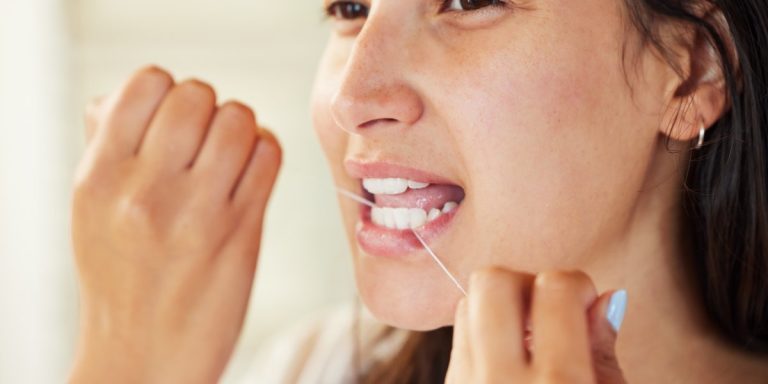
Dental floss cleans the space between your teeth and along the gumline, where your toothbrush can’t reach. Once a day is enough: curve it around each tooth in a C shape and slide it gently just below the gum. If the gaps between your teeth are wide, an interdental brush may clean better than floss.
Lots of people buy floss, use it for a week and give up because their gums bleed or they can’t get the hang of it. Here’s what it’s for, how to floss properly step by step, how to reach your back teeth, when an interdental brush is a better fit, and what to do if you wear braces, a retainer or a bridge.
Contents
What dental floss is for
It removes food trapped between your teeth and, above all, plaque: the film of bacteria that forms along the gumline. The American Dental Association (ADA) explains that toothbrush bristles don’t clean those tight gaps well, and that plaque left there can harden into tartar, which only a professional cleaning can remove.
The NHS, the UK’s public health service, adds that flossing regularly can help reduce gum disease, tooth decay and bad breath.
The evidence is modest, but it points the same way. A 2019 Cochrane review of 35 trials with 3,929 adults found that flossing in addition to brushing may reduce gum inflammation (gingivitis) at one, three and six months, with low-certainty evidence.
How to floss your teeth properly
These are the steps the NHS describes:
- Cut off 30 to 45 centimeters (about 12 to 18 inches) of floss or dental tape.
- Wind it around your fingers so you’re left with 3 to 4 centimeters (about an inch and a half) held tight between your hands.
- Slide the floss between two teeth with a gentle back-and-forth motion, without snapping it down onto the gum.
- Bring it down into the space between the tooth and the gum, as far as it goes without forcing it.
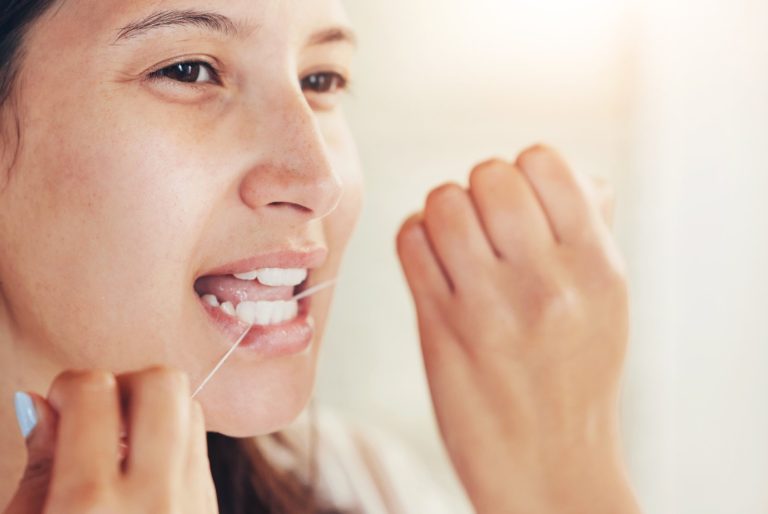
- Curve the floss into a C shape around one tooth and move it gently up and down to sweep away food and plaque. Repeat on the tooth next to it.
- Move to a clean section of floss for the next space.
The ADA doesn’t recommend reusing floss: it frays, cleans less well and can put bacteria from the last use back into your mouth. Use it once and throw it away.
How to floss your back teeth
Back teeth take more effort. Open your mouth wide, hold the floss with your thumbs for the upper teeth and with your index fingers for the lower ones, and shorten the tight section to get more control. Don’t forget the back side of the last molar on each side, which you also clean by wrapping the floss around it.
How to use a floss pick
A floss pick, also called a floss holder, has a short, tight piece of floss stretched between two prongs. It’s easier to handle with one hand and helps you reach your back teeth.
You use it the same way: slide it gently between your teeth, press it against one tooth and then the other, and move it up and down. The ADA includes it among accepted floss products. Since the piece of floss is short, rinse it between spaces or use a new one when it gets dirty.
How often to floss, and whether before or after brushing
The ADA recommends brushing twice a day and cleaning between your teeth once a day, at whatever time suits you: at night before bed, after lunch or in the morning. What matters is doing it every day.
As for the order, the NHS advises flossing before you brush. The ADA accepts either order as long as the cleaning is thorough, and notes that some people prefer to floss first so that brushing then sweeps away whatever came out from between the teeth.
Dental floss or interdental brush
Both work, and the choice depends on what the spaces between your teeth are like:
- Tightly spaced teeth. Floss gets in where an interdental brush won’t fit. The ADA recommends it for narrow spaces.
- Wide gaps or receding gums. An interdental brush cleans more surface. The ADA recommends it for periodontitis and for more open spaces, and the NHS suggests it as an alternative to floss, especially where there are gaps. The brush should fit snugly.
- What the evidence says. The 2019 Cochrane review concludes that interdental brushes may be more effective than floss at reducing gingivitis, with low-certainty evidence.
What isn’t recommended is using wooden toothpicks to dig out food: the NHS warns that they can damage the gum and open the door to an infection. If you’re not sure what suits you, at your oral cleaning we’ll show you how to use floss or an interdental brush in the size you need.
Flossing with braces, a retainer, bridges or implants
With a wire in the way, floss can’t go in from the top. That’s what these are for:
- Floss threader. A kind of flexible plastic needle that pulls the floss under the archwire of your braces, a fixed retainer or a bridge. The ADA lists it among floss products.
- Floss with a stiff end. Some floss for braces has a stiff end that works as a threader and a spongy section that cleans under the wire or the bridge.
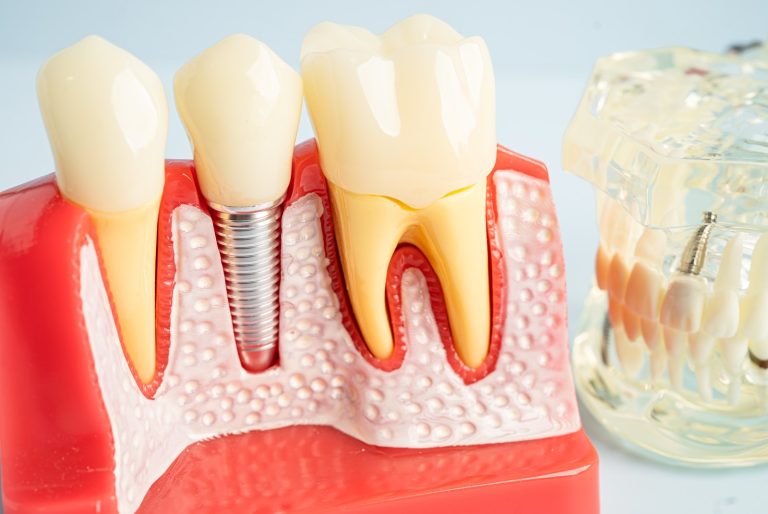
- Interdental brushes for implants. The ADA points out that brushes designed for implants have a coated wire, so they don’t scratch the implant.
If your gums bleed when you floss
The NHS lists bleeding when you brush or floss as one of the symptoms of gum disease. If your gums bleed, don’t stop flossing: in the early stages, the NHS explains, treatment starts with better cleaning between the teeth and a cleaning at the dental office.
If the bleeding continues, the article on solutions for bleeding gums covers the causes and what’s done in each case, and periodontics explains the treatment when there are pockets under the gum.
The first visit and the quote are free.
Oral cleaning
An ultrasonic clean: what it removes, how long it takes and how often to repeat it. Free assessment.
See the treatmentFrequently asked questions
Waxed or unwaxed dental floss?
It doesn’t matter. The ADA explains that there’s no difference in effectiveness between waxed and unwaxed floss; how and when you use it matters more.
What is dental floss made of?
It used to be made of silk fibers; today, according to the ADA, it’s made of nylon or plastic. Dental tape is a flatter, wider version.
Can you reuse dental floss?
No. The ADA recommends not using any interdental cleaner twice: it wears out, cleans less well and can put bacteria back into your mouth.
Dental floss or water flosser?
The 2019 Cochrane review found more support for floss and interdental brushes than for water flossers, whose evidence it describes as limited and inconsistent. A water flosser can be an add-on if you find floss hard to use.
Is it normal for flossing to hurt?
Floss gently, without snapping it against the gum. If it hurts or feels sore in the same spot every time, it’s worth having us take a look: gums inflamed by plaque often hurt and bleed when touched.